
The Mental Status Examination (MSE) is one of the core topics Psychiatric-Mental Health Nurse Practitioner (PMHNP) students should understand for both coursework and certification review. It gives you a consistent way to describe a patient’s current appearance, behavior, speech, emotions, thinking, perception, cognition, insight, and judgment.
Learning the MSE involves more than memorizing clinical terms. You need to know what each section evaluates, which findings come from the patient, which findings you observe, and how those details contribute to a psychiatric assessment.
If you are preparing for your PMHNP certification exam and want a more structured way to study topics like the Mental Status Examination, then we at Advanced NP Certification Review can help you build a study plan that fits your learning needs. To get started, you can book a free consultation to discuss your goals and learn how our review program can support your exam preparation.
What the Mental Status Examination Evaluates
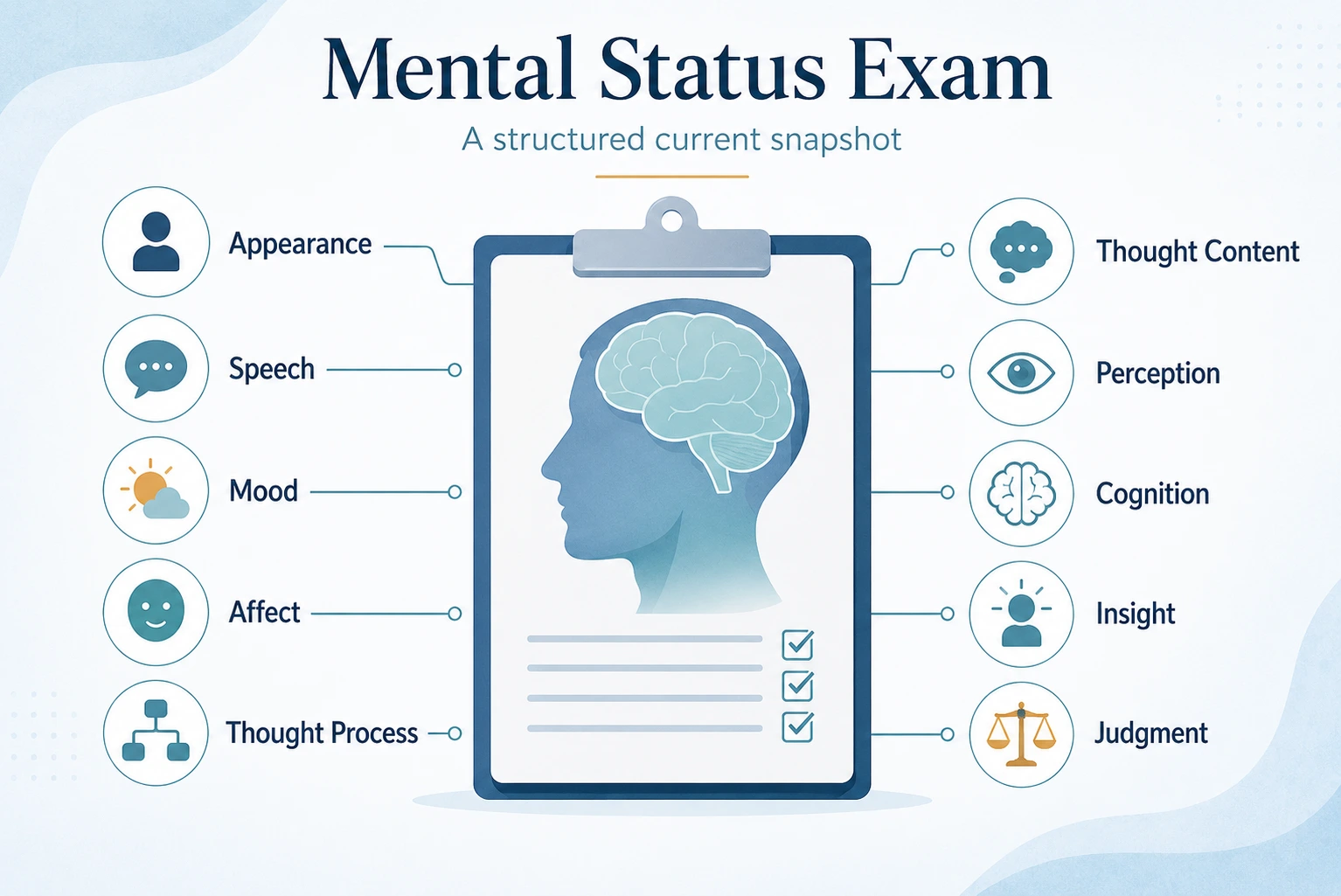
The MSE provides a structured description of a patient’s current behavioral, emotional, and cognitive presentation. It is used alongside the psychiatric history, safety assessment, reported symptoms, and other clinical information.
The main areas of the MSE include:
- Appearance and behavior: Observe grooming, clothing, posture, eye contact, movement, cooperation, and visible distress. Record what you see without making assumptions based on appearance alone.
- Speech: Consider the rate, volume, rhythm, fluency, and amount of speech. Speech may be rapid, slowed, pressured, soft, loud, or difficult to follow.
- Mood and affect: Mood describes the emotional state the patient reports. Affect describes the emotional expression you observe. You may also consider the range, intensity, stability, and appropriateness of the affect.
- Thought process: This describes how the patient organizes and connects ideas. Thought process may be logical and goal-directed, tangential, circumstantial, disorganized, or difficult to follow.
- Thought content: This refers to what the patient is thinking about. It may include worries, preoccupations, obsessions, delusions, or thoughts of self-harm or harm to others.
- Perception: Ask about hallucinations or other perceptual disturbances. Keep the patient’s reported experience separate from behavior you directly observe.
- Cognition: Assess relevant areas such as orientation, attention, concentration, memory, language, and abstract thinking. The level of detail may depend on the patient’s presentation.
- Insight and judgment: Insight reflects the patient’s awareness of the condition or situation. Judgment refers to the ability to make safe and appropriate decisions.
Why the MSE Matters During PMHNP Exam Preparation
If you are preparing for the PMHNP exam, understanding the MSE can help you organize information in patient scenarios and recognize what each finding means.
For example, a question may describe rapid speech, limited eye contact, a reported low mood, or impaired judgment. Knowing where each detail belongs helps you separate the findings and decide which information requires closer attention.
It is also helpful to understand commonly confused terms. Mood and affect are related but not interchangeable. Thought process and thought content describe different parts of the assessment. Insight and judgment may also differ, even when both seem impaired.
How to Review the MSE
Use the same order whenever you review a patient scenario. Ask yourself what the patient reported, what the clinician observed, and which MSE category applies.
Practice writing one clear sentence for each relevant category. This can help you become more comfortable organizing clinical information without relying only on memorized definitions.
Advanced NP Certification Review helps you connect foundational psychiatric concepts with organized study and exam-focused practice.
For personalized help reviewing the MSE and other PMHNP topics, contact us, and we’ll help you identify what to review next and how to practice it.

Leave a Reply